
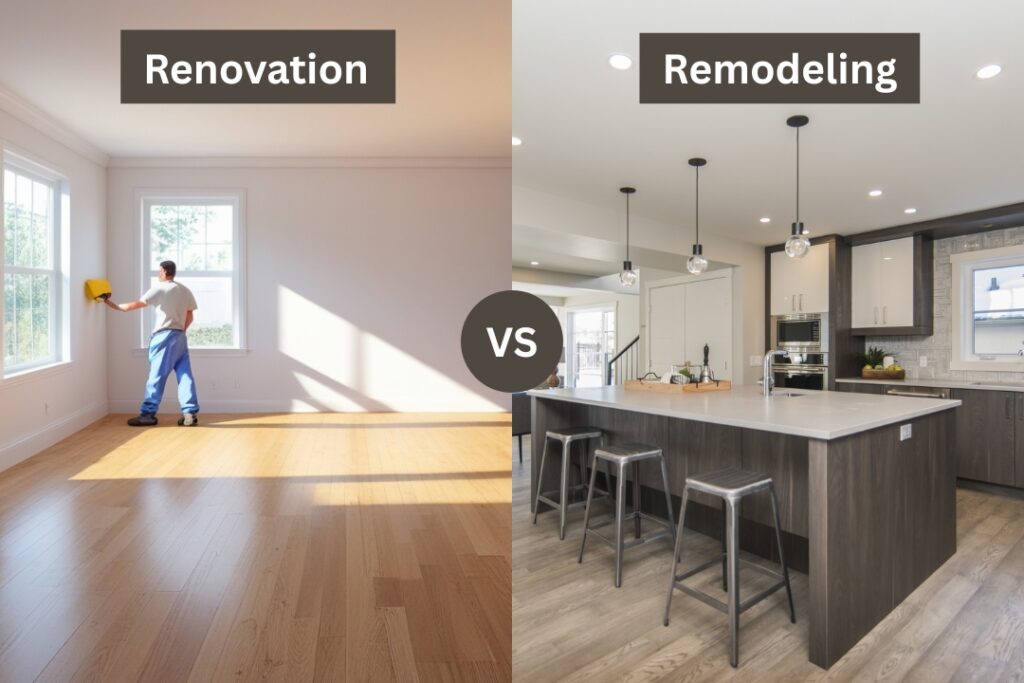
Renovating means updating what already exists, while remodeling involves changing the structure or function of a space. Although both improve your home, understanding their differences is key to planning your project, setting your budget, and achieving the results you want.
Thinking of upgrading your home? You’ve probably heard the words remodeling and renovating used like they mean the same thing.
But here’s the catch: while both improve your living space, they serve very different purposes.
Renovation is about refreshing what’s already there—think new paint, updated flooring, or restored cabinets.
Remodeling, on the other hand, means transforming the structure—knocking down walls, changing layouts, or adding entire rooms.
Knowing the difference isn’t just about semantics. It can help you set realistic goals, avoid budget surprises, and choose the right contractors.
Whether you want a modern facelift, better functionality, or a total overhaul—choosing the right path can save time, money, and stress.
Ready to transform your space with clarity? Dive deeper into the pros, cons, costs, and timelines of remodeling vs. renovating—and find out which option truly fits your home and your vision.
Although the terms “renovation” and “remodel” are often used interchangeably in casual conversation, they refer to two different types of home improvement. The main difference lies in scope and purpose.
Renovation focuses on repairing or updating existing elements without altering the layout. It enhances what is already there—bringing it back to life.
These improvements tend to be more budget-friendly and less invasive, making renovations ideal for homeowners who want to freshen up their space without undergoing major construction.
Remodeling is more involved. It involves restructuring—changing the form, layout, or even the purpose of a room or space.
Remodeling often requires architectural design, permits, and professional contractors. It takes more time and money but results in a more customized and functional living space.
Feature | Renovation | Remodeling |
Purpose | Refresh or update existing space | Change structure or layout |
Examples | Paint, fixtures, flooring | Room additions, wall removal |
Cost Range | Lower to moderate | Higher (often significantly) |
Time Required | Shorter (weeks) | Longer (weeks to months) |
Permits Needed | Rarely | Often required |
DIY-Friendly? | Yes, for small projects | Rarely (requires professionals) |
ROI (Return on Investment) | Typically higher for minor updates | Depends on scope and quality |
This table makes it clear: renovations are ideal for surface-level upgrades, while remodels tackle bigger transformations.
No, they are not the same. Renovating means updating or refreshing a space without changing its structure. Remodeling involves altering the layout, structure, or function of the space entirely.
Generally, no. Replacing flooring is usually considered a renovation, as it updates the appearance of the space without changing its structure or function.
Home improvement is a broad term that includes everything from painting to full-scale renovations or remodels. Remodeling is a type of home improvement focused on structural or layout changes.
Yes, painting is one of the most common renovation tasks. It improves the appearance of a space without changing its structure or layout.
Refurbishment typically refers to cleaning, repairing, or refreshing an area without major changes. Renovation can go further by upgrading materials and making more significant cosmetic improvements.
This includes anything from repainting walls and replacing fixtures to modernizing entire rooms—without altering the structure.

Decorapick was founded by someone who truly understands home improvement—not just as a business, but as a passion. The owner has years of hands-on experience transforming homes, one detail at a time. From choosing the right decor to maximizing small spaces, their goal is simple: help people fall in love with their homes again.
© 2025 Decorapick